内存访问密集型高性能计算
在并行计算和 GPU 优化中,我们通常会遇到两类主要瓶颈:计算限制(Compute-dominated)与访存限制(Memory-bound)。在之前的实验中,我们主要面对的是计算密集型任务。本章我们将视角转向到访存密集型工作负载。以**波动方程模拟(Wave Simulation),**其实不用理解其具体的物理/数学含义,只需要知道我们将模拟波随时间的变化,每个时间点,每个点的值,都依赖于这个点和这个点的邻居在上个时刻的点。可见需要频繁访问非局部数据。
对应的 cpu 代码如下:
template <typename Scene> void wave_cpu_step(float t, float *u0, float const *u1) {
    constexpr int32_t n_cells_x = Scene::n_cells_x;
    constexpr int32_t n_cells_y = Scene::n_cells_y;
    constexpr float c = Scene::c;
    constexpr float dx = Scene::dx;
    constexpr float dt = Scene::dt;

    for (int32_t idx_y = 0; idx_y < n_cells_y; ++idx_y) {
        for (int32_t idx_x = 0; idx_x < n_cells_x; ++idx_x) {
            int32_t idx = idx_y * n_cells_x + idx_x;
            bool is_border =
                (idx_x == 0 || idx_x == n_cells_x - 1 || idx_y == 0 ||
                 idx_y == n_cells_y - 1);
            float u_next_val;
            if (is_border || Scene::is_wall(idx_x, idx_y)) {
                u_next_val = 0.0f;
            } else if (Scene::is_source(idx_x, idx_y)) {
                u_next_val = Scene::source_value(idx_x, idx_y, t);
            } else {
                constexpr float coeff = c * c * dt * dt / (dx * dx);
                float damping = Scene::damping(idx_x, idx_y);
                u_next_val =
                    ((2.0f - damping - 4.0f * coeff) * u1[idx] -
                     (1.0f - damping) * u0[idx] +
                     coeff *
                         (u1[idx - 1] + u1[idx + 1] + u1[idx - n_cells_x] +
                          u1[idx + n_cells_x]));
            }
            u0[idx] = u_next_val;
        }
    }
}
接下来看看上述这类**访存限制(Memory-bound)**问题应该如何在GPU上进行优化。
GPU 的内存层次结构 (Memory Hierarchy)
为了优化内存密集型应用,我们必须深入了解目标硬件的内存架构。以 NVIDIA RTX 4000 Ada 为例,它拥有 4 层内存层次结构:
DRAM(全局内存/显存):容量 20 GB,带宽约 360 GB/sec。所有的数据通常都从这里出发,但它的速度相对最慢。
L2 缓存 (L2 Cache):48 MB,带宽大幅提升至 ~2.5 TB/sec。它是所有 SM(流式多处理器)共享的,常规的全局内存读写都会经过这里。
L1 缓存与共享内存 (L1 Cache / Shared Memory):每个 SM 拥有 128 KB 的 SRAM,带宽极高(全 GPU 聚合带宽可达 13.4 TB/sec)。
寄存器堆 (Register File):每个 Warp 调度器有 64 KB 的 SRAM,速度最快。
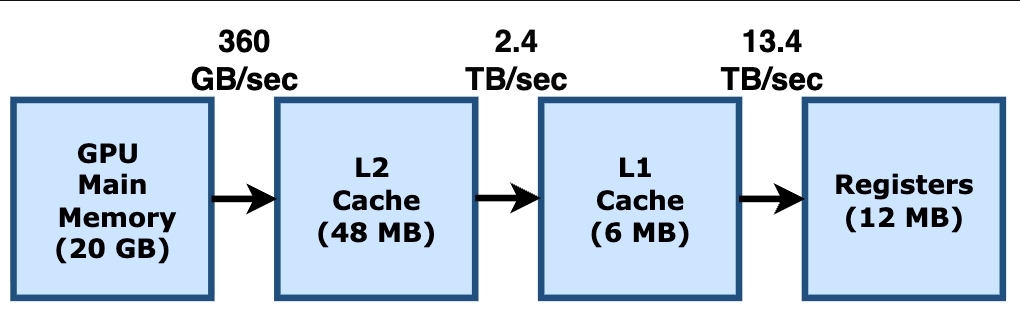
L1 缓存的特殊之处
与常规 CPU 不同,GPU 的 L1 缓存并不保证跨 SM 的一致性(Not Coherent)。因此,绝大多数常规的内存读写实际上会绕过(Bypass) L1 缓存。L1 在 GPU 中主要用于以下四个场景:
缓存 CUDA 的线程局部(Thread-local)内存(如 C 语言堆栈)。
缓存**只读(Read-only)**的全局内存(可以通过给指针加
const restrict或使用__ldg内联指令来触发)。缓存编译器认为未来可能发生变化但仍值得缓存的数据。
作为软件管理的 Scratchpad(即 CUDA 中的 Shared Memory):这是我们需要在代码中显式分配和管理的一块超高速存储。
各级存储访问延迟的直观感受
在更底层(PTX 虚拟汇编)的视角下,GPU 提供了不同的 Load 指令来控制缓存行为:
ld.global.ca:缓存在所有层级(L1 和 L2)。ld.global.cg:只缓存在 L2 缓存(绕过 L1)。ld.global.cv:不缓存(每次读取都会使得 L2 对应的 cache line 失效并重新拉取)。
可以利用这些命令结合实验感受各级存储访问的延迟差距。
__attribute__((optimize("O0"))) __global__ void l1_mem_latency(
    unsigned long *time_start,
    unsigned long *time_end,
    data_type *array_1,
    data_type *array_2) {
    unsigned long start_time, end_time;
    data_type value1 = 0.0f, result;
    unsigned long temp_addr;

    asm volatile(
        // L1 cache setup - load a zero and create offset address
       "ld.global.ca.u64 %0, [%5];\n\t"
        "add.u64 %0, %0, %5;\n\t"

        // warm-up
        "ld.global.ca.f32 %2, [%0];\n\t"

        "mov.u64 %1, %%clock64;\n\t"
        "ld.global.ca.f32 %2, [%0];\n\t"
        "mov.u64 %4, %%clock64;\n\t"

        "st.global.f32 [%5], %2;\n\t"
        : "=l"(temp_addr), "=l"(start_time), "=f"(result), "+f"(value1), "=l"(end_time)
        : "l"(array_2)
        : "memory");

    *time_start = start_time;
    *time_end = end_time;
    array_1[0] = result;
}

////////////////////////////////////////////////////////////////////////////////
// L2 Cache Memory Latency

__attribute__((optimize("O0"))) __global__ void l2_mem_latency(
    unsigned long *time_start,
    unsigned long *time_end,
    data_type *array_1,
    data_type *array_2) {
    unsigned long start_time, end_time;
    data_type value1 = 0.0f, result;
    unsigned long temp_addr;

    asm volatile(
        // L2 cache setup - load a zero and create offset address
        "ld.global.cg.u64 %0, [%5];\n\t"
        "add.u64 %0, %0, %5;\n\t"
        "membar.gl;\n\t"

        // warm-up(进入 L2)
        "ld.global.cg.f32 %2, [%0];\n\t"

        "mov.u64 %1, %%clock64;\n\t"
        "ld.global.cg.f32 %2, [%0];\n\t"
        "mov.u64 %4, %%clock64;\n\t"

        "st.global.f32 [%5], %2;\n\t"
        : "=l"(temp_addr), "=l"(start_time), "=f"(result), "+f"(value1), "=l"(end_time)
        : "l"(array_2)
        : "memory");

    *time_start = start_time;
    *time_end = end_time;
    array_1[0] = result;
}

////////////////////////////////////////////////////////////////////////////////
// Global Memory Latency

__attribute__((optimize("O0"))) __global__ void global_mem_latency(
    unsigned long *time_start,
    unsigned long *time_end,
    volatile data_type *array_1,
    volatile data_type *array_2) {
    unsigned long start_time, end_time;
    data_type value1 = 0.0f, result;

    asm volatile(
        // Measure memory load latency directly - no warm-up access
        "membar.gl;\n\t"
        "mov.u64 %0, %%clock64;\n\t"

        "ld.global.cv.f32 %1, [%3];\n\t"

        "mov.u64 %4, %%clock64;\n\t"
        "st.global.f32 [%3], %1;\n\t"
        : "=l"(start_time), "=f"(result), "+f"(value1), "+l"(array_2), "=l"(end_time)
        :
        : "memory");

    *time_start = start_time;
    *time_end = end_time;
    array_1[0] = result;
}
./mem-latency
global_mem_latency latency =    475 cycles
l2_mem_latency latency =        6 cycles
l1_mem_latency latency =        6 cycles
内存访问合并
同一 Warp(32 个cuda线程)的内存访问应当是连续的。
Coalesced Load(合并加载):当 Warp 内的各个线程读取连续的内存地址时,GPU 可以通过单次(或极少数几次)内存事务(Transaction)取回所有数据。
Non-coalesced Load(非合并加载/步长加载):如果各个线程访问的地址步长很大(Stride),内存请求会被打散成大量的离散事务,导致内存延迟飙升,带宽利用率断崖式下跌。
Bank conflict
在 GPU 的 Shared Memory(共享内存) 优化中,Bank Conflict(存储体冲突) 是最常见的性能杀手之一。
为了实现极高的带宽,Shared Memory 被平均分成 32 个等大小的内存模块,称为 Banks(存储体)。
在逻辑上,连续的 4 字节(
float或int32)被轮流映射到这 32 个 Bank 中。规则:第 n 个地址映射到第 n % 32 个 Bank。
在一个 Warp(32 个线程)执行内存指令时,如果所有线程访问的地址分别指向 32 个不同的 Banks,那么这些访问可以 100% 并行完成。
如果 Warp 中有两个或更多线程请求的地址落在 同一个 Bank 中,这些请求就无法同时处理。
硬件必须将这些冲突的请求串行化(Serializing)。例如,如果有 2 个线程冲突,耗时就会翻倍(2-way conflict)。
最典型的例子是跨步访问(Strided Access):
如果线程 i 访问
shared_data[i * 2],那么线程 0 访问 Bank 0,线程 1 访问 Bank 2… 看起来没问题。但如果步长是 32 的倍数(例如访问二维数组的列,且行宽是 32),所有 32 个线程都会请求同一个 Bank,导致严重的 32-way conflict,性能瞬间跌至 1/32。
优化技巧
最经典的技巧是 Padding(填充):
在定义二维 Shared Memory 数组时,故意把列宽增加 1。
例如:原本是
shared float data[32][32],改为data[32][33]。原理:这样每一行的起始地址在 Bank 中的偏移都会错开 1 位,原本纵向对齐到同一个 Bank 的元素,现在会分布在不同的 Bank 中,从而完美消除冲突。
内存访问密集型高性能实战
Naive 实现
先看 naive gpu实现
template <typename Scene>
__global__ void wave_gpu_naive_step(
    float t,
    float *u0,      /* pointer to GPU memory */
    float const *u1 /* pointer to GPU memory */
) {
    constexpr int32_t n_cells_x = Scene::n_cells_x;
    constexpr int32_t n_cells_y = Scene::n_cells_y;
    constexpr float c = Scene::c;
    constexpr float dx = Scene::dx;
    constexpr float dt = Scene::dt;

    const int idx_x = blockIdx.x * blockDim.x + threadIdx.x;
    const int idx_y = blockIdx.y * blockDim.y + threadIdx.y;
    const int idx = idx_y * n_cells_x + idx_x;

    if (idx_x >= n_cells_x || idx_y >= n_cells_y) {
        return;
    }

    bool is_border =
        (idx_x == 0 || idx_x == n_cells_x - 1 || idx_y == 0 ||
            idx_y == n_cells_y - 1);
    float u_next_val;
    if (is_border || Scene::is_wall(idx_x, idx_y)) {
        u_next_val = 0.0f;
    } else if (Scene::is_source(idx_x, idx_y)) {
        u_next_val = Scene::source_value(idx_x, idx_y, t);
    } else {
        constexpr float coeff = c * c * dt * dt / (dx * dx);
        float damping = Scene::damping(idx_x, idx_y);
        u_next_val =
            ((2.0f - damping - 4.0f * coeff) * u1[idx] -
                (1.0f - damping) * u0[idx] +
                coeff *
                    (u1[idx - 1] + u1[idx + 1] + u1[idx - n_cells_x] +
                    u1[idx + n_cells_x]));
    }
    u0[idx] = u_next_val;
}

template <typename Scene>
std::pair<float *, float *> wave_gpu_naive(
    float t0,
    int32_t n_steps,
    float *u0, /* pointer to GPU memory */
    float *u1  /* pointer to GPU memory */
) {
    const int n_cells_x = Scene::n_cells_x;
    const int n_cells_y = Scene::n_cells_y;

    dim3 blockDim(block_dim_x, block_dim_y);
    dim3 gridDim(
        (n_cells_x + block_dim_x - 1) / block_dim_x,
        (n_cells_y + block_dim_y - 1) / block_dim_y
    );

    for (int32_t step = 0; step<n_steps; ++step) {
        float t = t0 + step * Scene::dt;
        wave_gpu_naive_step<Scene><<<gridDim, blockDim>>>(t, u0, u1);
        std::swap(u0, u1);
    }

    return {u0, u1};
}
最直观的 GPU 实现方式是将上述算法直接翻译为 Kernel 函数:
为网格中的每个像素分配一个线程。
每个线程在 Kernel 内从 Global Memory 读取自己的当前值、历史值和四个邻居的值。
计算结果,写回 Global Memory。
痛点:对于计算每个像素点,我们需要从 Global Memory 读取至少 5 个值并写入 1 个值。在这个过程中,邻居像素被相邻线程重复读取了极多次。面对极高的全局内存带宽压力,计算单元被迫处于饥饿状态等待数据。
分析与对比
Small scale tests (on scene 'DoubleSlitSmallScale'):
  CPU sequential implementation:
    run time: 603.79 ms

  GPU naive implementation:
    run time: 4.30 ms
    correctness: 3.13e-06 relative RMSE

  GPU shared memory implementation:
    run time: 1.85 ms
    correctness: 4.04e-06 relative RMSE

  CPU -> GPU naive speedup: 140.52x
  CPU -> GPU shared memory speedup: 326.59x
  GPU naive -> GPU shared memory speedup: 2.32x

Large scale tests (on scene 'DoubleSlit'):
  GPU naive implementation:
    run time: 2363.80 ms

  GPU shared memory implementation:
    run time: 1500.22 ms
    correctness (w.r.t. GPU naive): 9.01e-05 relative RMSE

  GPU naive -> GPU shared memory speedup: 1.58x