GPU 上动态的调度 —— 从run-length-compression说起
之前的例子中,我们对GPU的HBM的访问模式是静态可确定的,比如访问多少数据,访问的频率、模式等在代码编译阶段就已经确定。
现实中另外一类常见的case是,GPU对HBM的访问模式需要在runtime时,根据输入的计算结果,动态决定,也就是GPU的动态调度问题。
接下来我们用run-length encoding(RLE,游程压缩)的实现来说明这里动态调度的高性能计算如何在GPU上高效实现。
并行扫描问题
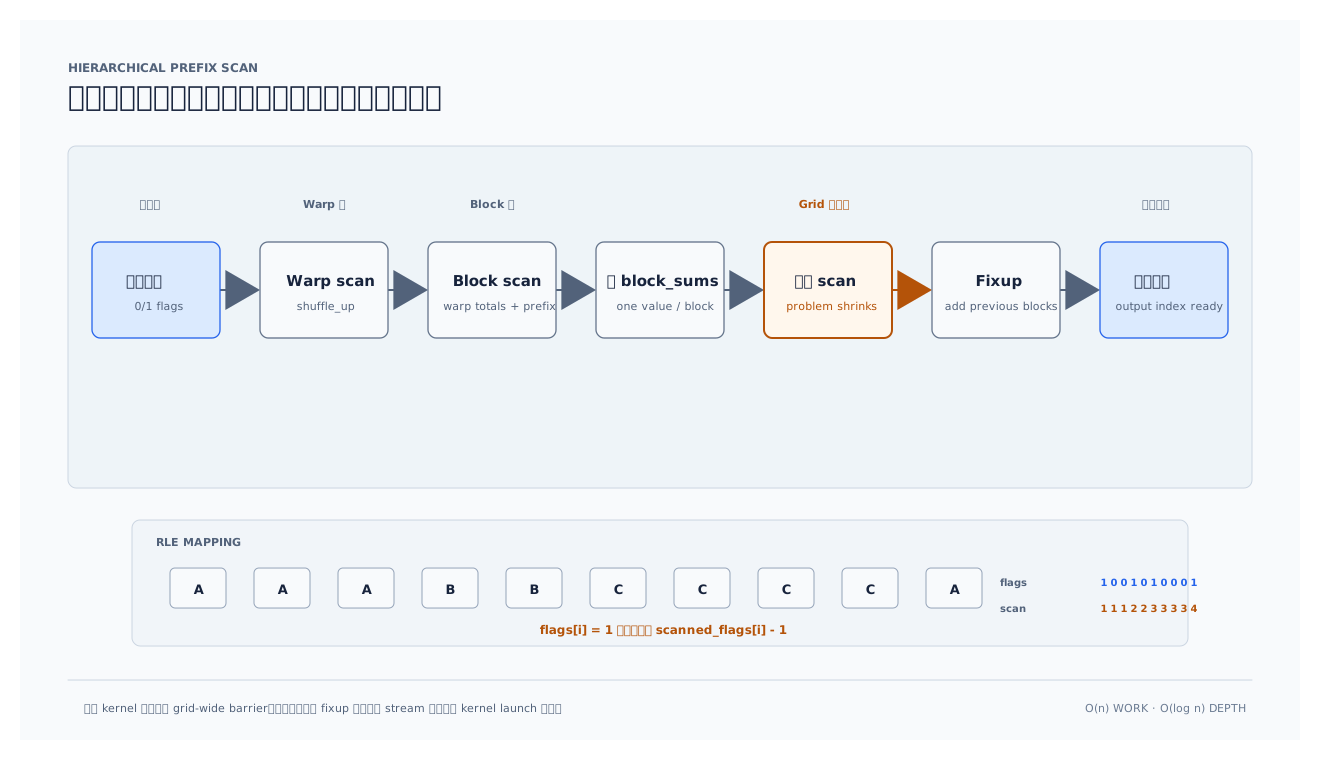
RLE 需要先判断每个位置是否为新 run 的起点,再把这些起点压缩写入连续的输出位置。每个线程可以独立完成判断,但它只有知道“前面已经出现了多少个起点”,才能确定自己的输出下标。这个从标记到位置的转换,就是 scan。
Scan 把前缀依赖改写成树形归并
给定输入 x[0..n-1]、二元运算 ⊕ 和单位元 e,scan 有两种常见定义:
类型 |
定义 |
输入 [3, 1, 7, 0] |
|---|---|---|
Inclusive scan |
|
|
Exclusive scan |
|
|
本节代码实现的是 inclusive scan。RLE 的起点标记是 0/1 数组,因此 scanned_flags[i] 表示从位置 0 到位置 i 一共出现了多少个 run。
scan 能够并行化,依赖的是运算符的结合律:
(a ⊕ b) ⊕ c = a ⊕ (b ⊕ c)
结合律允许算法先并行合并相邻片段,再逐层合并片段结果。运算不必满足交换律,因为 Op::combine(left, right) 始终保留输入顺序。加法、最大值和逻辑或都可以作为 scan 运算;减法不满足结合律,不能直接套用这套算法。
GPU 用三级层次处理不同范围的数据依赖
范围 |
通信方式 |
本节实现 |
同步边界 |
|---|---|---|---|
Warp 内 |
寄存器之间交换 |
|
warp 级原语 |
Block 内 |
只把每个 warp 的总和放入 shared memory |
两次 warp scan |
|
Grid 内 |
把每个 block 的总和写入 global memory |
递归 scan + fixup |
同一 CUDA stream 中的 kernel 顺序 |
这套层次化结构把一个长度为 n 的问题不断缩小:线程先在 warp 内合并,warp 再在 block 内合并,最后只对数量很少的 block_sums 递归执行同样的过程。固定 warp 和 block 大小时,总工作量随 n 线性增长;每一级的依赖深度则是对数级。
Warp scan
使用 __shfl_up_sync,每一轮从 delta 个 lane 之前拿一个值过来,然后与当前线程的局部前缀合并:
template <typename Word, typename T>
__device__ __forceinline__ Word pack_bits(const T &v) {
    static_assert(
        sizeof(Word) >= sizeof(T),
        "Word size must be greater than or equal to size of T");
    static_assert(std::is_trivially_copyable_v<T>, "type T should be trivally copyable");
    Word word;
    std::memcpy(&word, &v, sizeof(T));
    return word;
}

template <typename Word, typename T>
__device__ __forceinline__ T unpack_bits(const Word &bits) {
    static_assert(
        sizeof(Word) >= sizeof(T),
        "Word size must be greater than or equal to size of T");
    static_assert(std::is_trivially_copyable_v<T>, "type T should be trivally copyable");
    T v;
    std::memcpy(&v, &bits, sizeof(T));
    return v;
}

template <typename T>
__device__ __forceinline__ T shuffle_up_any(unsigned int mask, T v, int delta) {
    static_assert(
        sizeof(T) <= sizeof(uint64_t),
        "do not support type that size is greater than 8");
    if constexpr (sizeof(T) <= sizeof(int)) {
        auto bits = pack_bits<int, T>(v);
        auto other_bits = __shfl_up_sync(mask, bits, delta);
        return unpack_bits<int, T>(other_bits);
    }
    auto bits = pack_bits<long long, T>(v);
    auto other_bits = __shfl_up_sync(mask, bits, delta);
    return unpack_bits<long long, T>(other_bits);
}

template <typename Op> __device__ typename Op::Data warp_scan(typename Op::Data v) {
    using Data = typename Op::Data;
    unsigned int mask = 0xffffffff;

    int lane = threadIdx.x & (WARP_SIZE - 1);
#pragma unroll
    for (int i = 1; i < WARP_SIZE; i *= 2) {
        Data other = Op::identity();
        other = shuffle_up_any(mask, v, i);
        if (lane >= i) {
            v = Op::combine(other, v);
        }
    }

    return v;
}
pack_bits 复制位模式,不做数值转换
pack_bits 和 unpack_bits 为 shuffle 准备传输载体。它们使用 std::memcpy 复制对象表示,不执行 static_cast,因此浮点数或小结构体的每一位都能原样保留,也不会触发违反 strict aliasing 的类型重解释。
约束 |
作用 |
|---|---|
|
载体必须容纳 T 的全部字节 |
|
保证对象表示可以通过 |
unpack_bits 把相同数量的字节复制回 T,完成位模式的往返。
shuffle_up_any 把小对象接入 warp shuffle
shuffle_up_any 把不超过 8 字节的 trivially copyable 类型分成两条路径:
sizeof(T) <= 4:打包成 32 位int。4 < sizeof(T) <= 8:打包成 64 位long long。
if constexpr 在编译期选择分支,没有运行时判断。__shfl_up_sync(mask, bits, delta) 让当前 lane 读取物理编号为 lane-delta 的寄存器值,数据直接经过 warp shuffle 网络传递,不经过 shared memory。
这个封装 shuffle 的是对象位模式,因此不仅能处理 uint32_t,也能处理大小不超过 8 字节的小型结构体。它不支持更大的类型;更大对象需要拆成多个 32 位或 64 位 word,分别执行 shuffle。
五轮倍增构造 inclusive scan
warp_scan 是一个 warp 内的 inclusive scan。假设 lane j 的输入是 x[j],返回值为:
lane 0: x[0]
lane 1: combine(x[0], x[1])
lane 2: combine(combine(x[0], x[1]), x[2])
...
lane 31: combine(x[0], ..., x[31])
循环中的距离依次为 1、2、4、8、16。每轮结束后,一个 lane 已知的连续前缀长度翻倍:
|
当前 lane 最多合并的连续元素数 |
|---|---|
1 |
2 |
2 |
4 |
4 |
8 |
8 |
16 |
16 |
32 |
当 lane >= i 时,当前 lane 才拥有合法的左侧来源,于是执行 Op::combine(other, v)。参数顺序很重要:other 是左侧较早出现的前缀,v 是右侧当前前缀。这样即使 combine 不满足交换律,也能保持从 lane 0 到当前 lane 的顺序。算法要求 combine 满足结合律,否则并行分组可能改变结果。
Op 需要提供 Data 类型和 combine(left, right)。
八个 lane 的求和示例
用前 8 个 lane 演示加法 scan,初始输入为 [1,2,3,4,5,6,7,8]:
初始:    [1, 2, 3, 4, 5, 6, 7, 8]
delta=1:[1, 3, 5, 7, 9, 11, 13, 15]
delta=2:[1, 3, 6, 10, 14, 18, 22, 26]
delta=4:[1, 3, 6, 10, 15, 21, 28, 36]
每个 lane 最终得到包含自身的前缀和,因此这是 inclusive scan。最后一个有效 lane 的结果同时也是整个 warp 的 reduction。若要得到 exclusive scan,可以把 inclusive 结果再向上移动一个 lane,并让 lane 0 返回单位元。
使用前提和代码边界
mask = 0xffffffff要求 32 个 lane 都处于活动且收敛的状态,并以相同 mask 执行该 intrinsic。部分 warp 或分支内调用需要构造正确的参与者 mask;仅替换成__activemask()也不会自动把稀疏 lane 压缩成连续序列。threadIdx.x & (WARP_SIZE-1)只在一维 block,或blockDim.x是 warp 大小整数倍时,才能等价于真实 lane ID。多维 block 的稳妥写法是先计算线性 thread ID,再对 32 取模。循环假设
WARP_SIZE是 2 的幂;在 NVIDIA CUDA 上通常取 32。当前文件中没有给出它的定义,需要由外部头文件或常量提供。低于
delta的 lane 会忽略 shuffle 返回值,因此不需要先把other设成Op::identity()。可以直接写成Data other = shuffle_up_any(mask, v, i);。算法只在 warp 内交换寄存器,不需要 shared memory,也不需要
__syncthreads()。跨 warp 的 block scan 仍需额外的 warp totals、共享内存和 block 级同步。
Block scan
只做 warp 内 scan 还不够,因为一个 block (通常)有 1024 个线程,也就是 32 个 warp。当前实现的 block_scan 使用了标准的两级结构:
每个 warp 先独立做自己的 inclusive scan。
每个 warp 的最后一个 lane 把该 warp 的总和写入 shared memory。
第 0 个 warp 再对这些 warp sums 做一次 scan。
除了第 0 个 warp 之外,其他 warp 再把自己的 warp prefix 加回本 warp 内的局部结果。
这就是一个很典型的 hierarchical scan。
template <typename Op>
__device__ typename Op::Data
block_scan(typename Op::Data v, typename Op::Data *shared_warp_sums) {
    using Data = typename Op::Data;

    int lane = threadIdx.x & (WARP_SIZE - 1);
    int warp_id = threadIdx.x / WARP_SIZE;

    v = warp_scan<Op>(v);
    if (lane == WARP_SIZE - 1) {
        shared_warp_sums[warp_id] = v;
    }

    __syncthreads();

    Data *scaned_warp_sums = shared_warp_sums;

    if (warp_id == 0) {
        Data warp_sum =
            lane < NUM_WARPS_PER_BLOCK ? shared_warp_sums[lane] : Op::identity();
        Data sum = warp_scan<Op>(warp_sum);
        scaned_warp_sums[lane] = sum;
    }

    __syncthreads();

    if (warp_id > 0) {
        Data prefix = scaned_warp_sums[warp_id - 1];
        v = Op::combine(prefix, v);
    }

    return v;
}
两个 warp 如何拼成一个 block scan
为了缩短例子,假设一个 block 有 8 个线程,每个 warp 只有 4 个 lane。输入为:
warp 0: [2, 1, 3, 4]
warp 1: [5, 2, 1, 6]
阶段 |
warp 0 |
warp 1 |
shared_warp_sums |
|---|---|---|---|
各自做 local scan |
|
|
|
warp 0 扫描各 warp 总和 |
不变 |
不变 |
|
加回前面 warp 的总和 |
|
|
|
warp 1 需要的前缀是 scanned_warp_sums[0] = 10,也就是它前面所有 warp 的总和。warp 0 前面没有数据,因此不做修正。最终结果为 [2, 3, 6, 10, 15, 17, 18, 24]。
这一实现只在 shared memory 中保存每个 warp 的一个总和。一个 1024 线程 block 有 32 个 warp,因此第二次 scan 最多处理 32 个值,正好由 warp 0 一次完成。两次 __syncthreads() 分别保证:
warp 0 开始读取前,所有 warp 都已经写出自己的总和;
其他 warp 读取前,warp 0 已经写完
scanned_warp_sums。
数组最后一个 block 可能只有部分有效元素。代码仍启动完整的 BLOCK_SIZE 个线程,让越界线程贡献单位元。只要单位元满足 e ⊕ x = x,最后一个线程得到的值仍是该 block 所有有效元素的总和。
warp_id-1 把 inclusive 总和变成跨 warp 偏移
第二次 warp_scan 结束后,scanned_warp_sums[q] 表示从 warp 0 到 warp q 的 inclusive 总和。warp p 的局部结果已经包含本 warp 的数据,因此只需要补上它之前所有 warp 的总和:
warp 0 的偏移:identity
warp 1 的偏移:scanned_warp_sums[0]
warp 2 的偏移:scanned_warp_sums[1]
...
warp p 的偏移:scanned_warp_sums[p-1]
这就是第 82 行读取 warp_id-1 的原因。warp 0 前面没有其他 warp,所以通过 if (warp_id > 0) 保留原来的局部前缀。Op::combine(prefix, v) 中,跨 warp 前缀放在左边,本 warp 的局部前缀放在右边;对于不满足交换律、但满足结合律的运算,这个顺序仍能保持原始线程顺序。
共享数组被原地改写为 warp 前缀
scaned_warp_sums 只是 shared_warp_sums 的别名,没有申请第二块 shared memory。数据在同一个数组中经历两个状态:
阶段 |
数组含义 |
|---|---|
第一次同步前 |
每个 warp 的最后一个 lane 写入本 warp 总和 |
warp 0 执行第二次 scan 后 |
数组被覆盖为各 warp 总和的 inclusive 前缀 |
这种原地复用是安全的,因为第一次 __syncthreads() 之后,warp 0 先把需要的 warp totals 读入寄存器,再执行 warp scan 和写回。第二次 __syncthreads() 保证其他 warp 读取时,覆盖后的前缀已经可见。变量名中的 scaned 是拼写问题,可以改为 scanned_warp_sums,不影响执行结果。
grid 级 scan:递归扫描 block sums
单个 block 的结果还只是局部前缀和。要把整个数组拼起来,当前代码进一步引入了两个全局缓冲区:
block_sums:每个 block 的总和scanned_block_sums:对block_sums再做一次 scan 的结果
整个流程是:
blocks_scan_no_fixup对每个 block 内做扫描,并写出output和block_sums。launch_scan_recursive递归地对block_sums做同样的扫描,得到scanned_block_sums。fixup_kernel把前面所有 block 的前缀值加回当前 block 的每个元素。
template <typename Op>
__global__ void blocks_scan_no_fixup(
    const typename Op::Data *input,
    size_t n,
    typename Op::Data *output,
    typename Op::Data *block_sums) {

    using Data = typename Op::Data;
    extern __shared__ unsigned char sh_mem_raw[];

    int tid = blockIdx.x * blockDim.x + threadIdx.x;

    Data v = tid < n ? input[tid] : Op::identity();

    Data *shared_warp_sums = reinterpret_cast<Data *>(sh_mem_raw);
    v = block_scan<Op>(v, shared_warp_sums);

    if (tid < n) {
        output[tid] = v;
    }

    if (threadIdx.x == blockDim.x - 1 && block_sums != nullptr) {
        block_sums[blockIdx.x] = v;
    }
}

template <typename Op>
__global__ void
fixup_kernel(typename Op::Data *output, typename Op::Data *scanned_block_sums, size_t n) {
    using Data = typename Op::Data;
    int tid = blockIdx.x * blockDim.x + threadIdx.x;

    if (tid >= n) {
        return;
    }

    if (blockIdx.x == 0) {
        return;
    }

    Data prefix = scanned_block_sums[blockIdx.x - 1];
    output[tid] = Op::combine(prefix, output[tid]);
}
跨 block 拼接仍然使用同一个模式
沿用上面的 8 个输入,假设每个 block 处理 4 个元素:
阶段 |
block 0 |
block 1 |
|---|---|---|
局部 scan |
|
|
写出 block 总和 |
|
|
扫描 |
|
|
fixup |
不加前缀 |
每个元素加 |
全局结果 |
|
|
如果 block_sums 仍然超过一个 block 能处理的范围,launch_scan_recursive 会再次生成更高一层的 block sums。输入规模每递归一层大约缩小为原来的 1 / BLOCK_SIZE,直到只剩一个 block。
CUDA 没有供普通 kernel 使用的隐式 grid-wide barrier,因此这段实现把全局同步拆成多次 kernel launch。同一 stream 中,后提交的 kernel 会在前一个 kernel 完成后再观察其结果。实际提交顺序为:
scan level 0 local blocks
  → scan level 1 block_sums
    → scan level 2 block_sums
    → fixup level 1
  → fixup level 0
递归发生在 host 端,它负责依次提交 kernel,并不表示 GPU 线程在 kernel 内递归。若这些 kernel 被改到不同 stream,需要用 event 或其他同步方式显式建立依赖。
局部扫描同时产出 output 和 block_sums
blocks_scan_no_fixup 让一个线程对应一个输入元素,tid = blockIdx.x * blockDim.x + threadIdx.x。每个 block 调用前一节的 block_scan,因此此时得到的 v 只包含当前 block 内的 inclusive prefix,还没有计入更早的 block。
这个 kernel 写出两类结果:
输出 |
写入者 |
含义 |
|---|---|---|
|
每个有效线程 |
当前 block 内的局部 inclusive prefix |
|
block 的最后一个线程 |
整个 block 的 reduction |
block_sums != nullptr 让第二类输出成为可选项。当上层不再需要继续递归时,可以传入空指针,避免写出 block totals。函数名中的 no_fixup 表示第一类输出仍是局部前缀,必须等更高层的 block sums 被扫描后再修正。
尾块用单位元保持完整同步结构
最后一个 block 往往装不满。代码没有让越界线程提前返回,而是让它们参与完整的 block_scan:
Data v = tid < n ? input[tid] : Op::identity();
这样所有线程仍会到达 block_scan 内的两次 __syncthreads(),不会产生 barrier divergence。只要 identity 满足 combine(x, identity) = x,位于有效数据之后的填充线程就不会改变 block 总和。越界线程不写 output,但最后一个物理线程仍可把有效元素的总和写进 block_sums。
fixup 把局部前缀改成全局前缀
递归扫描完成后,scanned_block_sums[b] 表示 block 0 到 block b 的 inclusive 总和。block b 的每个局部结果需要加上它之前所有 block 的总和,因此读取:
Data prefix = scanned_block_sums[blockIdx.x - 1];
output[tid] = Op::combine(prefix, output[tid]);
block 0 前面没有数据,原来的局部前缀已经等于全局前缀,所以直接返回。越界线程也可以提前返回,因为 fixup_kernel 中没有 block barrier。这里的 scanned_block_sums 只读不写,参数可以声明为 const Data *。
fixup 必须使用与局部扫描相同的 block 切分,使 blockIdx.x 仍对应同一段输入。Op::combine(prefix, output[tid]) 的顺序也必须保持不变,才能支持满足结合律但不满足交换律的操作。
整体scan 流程
template <typename Op>
void launch_scan_recursive(
    typename Op::Data *input,
    size_t n,
    typename Op::Data *output,
    unsigned char *workspace,
    size_t workspace_offset) {
    using Data = typename Op::Data;
    // int tid = blockIdx.x * blockDim.x + threadIdx.x;

    if (n == 0) {
        return;
    }

    int num_blocks = (n + BLOCK_SIZE - 1) / BLOCK_SIZE;
    size_t shared_bytes = 2 * NUM_WARPS_PER_BLOCK * sizeof(Data);
    if (num_blocks == 1) {
        blocks_scan_no_fixup<Op>
            <<<1, BLOCK_SIZE, shared_bytes>>>(input, n, output, nullptr);
        CUDA_CHECK(cudaGetLastError());
        return;
    }

    Data *block_sums = reinterpret_cast<Data *>(workspace + workspace_offset);
    workspace_offset += num_blocks * sizeof(Data);
    workspace_offset = (workspace_offset + 256) & ~255;

    Data *scanned_block_sums = reinterpret_cast<Data *>(workspace + workspace_offset);
    workspace_offset += num_blocks * sizeof(Data);
    workspace_offset = (workspace_offset + 256) & ~255;

    blocks_scan_no_fixup<Op>
        <<<num_blocks, BLOCK_SIZE, shared_bytes>>>(input, n, output, block_sums);
    CUDA_CHECK(cudaGetLastError());

    launch_scan_recursive<Op>(
        block_sums,
        num_blocks,
        scanned_block_sums,
        workspace,
        workspace_offset);
    CUDA_CHECK(cudaGetLastError());

    fixup_kernel<Op>
        <<<num_blocks, BLOCK_SIZE, shared_bytes>>>(output, scanned_block_sums, n);
    CUDA_CHECK(cudaGetLastError());
}

template <typename Op>
typename Op::Data *launch_scan(
    size_t n,
    typename Op::Data *x, // pointer to GPU memory
    void *workspace       // pointer to GPU memory
) {
    using Data = typename Op::Data;
    Data *output = reinterpret_cast<Data *>(workspace);
    size_t workspace_offset = n * sizeof(Data);
    launch_scan_recursive<Op>(
        x,
        n,
        output,
        reinterpret_cast<unsigned char *>(workspace),
        workspace_offset);
    return output;
}
RLE 例子:scan 怎样把动态输出变成确定下标
输入字符串为 AAABBCCCCA。每个线程只比较当前位置与前一个位置,得到 run 起点标记:
index:          0 1 2 3 4 5 6 7 8 9
raw:            A A A B B C C C C A
flags:          1 0 0 1 0 1 0 0 0 1
inclusive scan: 1 1 1 2 2 3 3 3 3 4
只有 flags[i] == 1 的线程参与写出。它的输出下标为 scanned_flags[i] - 1:
输入位置 |
字符 |
scan 值 |
输出下标 |
|---|---|---|---|
0 |
A |
1 |
0 |
3 |
B |
2 |
1 |
5 |
C |
3 |
2 |
9 |
A |
4 |
3 |
于是 compressed_data = [A, B, C, A],run_starts = [0, 3, 5, 9]。相邻起点相减得到 compressed_lengths = [3, 2, 4, 1]。最后一个 scan 值 4 同时就是 run 的数量。
这套实现为什么高效
设计 |
减少的成本 |
|---|---|
Warp 中用 shuffle |
避免为每一轮前缀传播读写 shared memory |
Block 中只保存 warp totals |
shared memory 用量从每线程一个元素缩小到每 warp 一个元素 |
只递归扫描 block totals |
更高层输入迅速缩小,绝大多数数据只参与底层扫描 |
单独执行 fixup |
用规则、合并的全局内存访问把 block 前缀批量加回 |
尾部线程使用单位元 |
主循环无需为最后一个 block 维护另一套算法 |
对固定的 warp 和 block 大小,算术工作量为 O(n),额外的 block summaries 形成几何递减序列。当前递归多 kernel 实现便于理解和验证,代价是额外的 kernel launch、block_sums 流量以及一次 fixup 读写。
递归只处理逐层缩小的 block_sums
launch_scan_recursive 是 host 函数,不是 GPU kernel。它每一层先计算 num_blocks = ceil(n / BLOCK_SIZE)。当 num_blocks == 1 时,一个 block 已经能扫描完整输入,直接启动一次 blocks_scan_no_fixup,并把 block_sums 设为空指针;此时局部前缀就是全局前缀,不需要继续递归,也不需要 fixup。
当输入需要多个 block 时,本层先生成长度为 num_blocks 的 block_sums,再递归扫描这段更短的数据。递归规模满足:
n_next = ceil(n_current / BLOCK_SIZE)
因此递归深度约为 log_BLOCK_SIZE(n)。对于当前 BLOCK_SIZE=1024,每深入一层,元素数量约缩小 1024 倍。
workspace_offset 让各递归层互不覆盖
当前层从 workspace + workspace_offset 依次切出两段 GPU 缓冲区:
缓冲区 |
元素数 |
用途 |
|---|---|---|
|
|
保存当前层每个 block 的 reduction |
|
|
保存递归扫描后的 block 前缀 |
两段空间分配完成后,更新后的 workspace_offset 被传给下一层递归,所以更高层只会从后续地址继续分配。递归返回时,本层的 scanned_block_sums 仍然有效,可供 fixup_kernel 使用。
代码使用 (offset + 256) & ~255 做 256 字节对齐。它能得到对齐地址,但当 offset 原本已经对齐时,仍会额外跳过 256 字节。标准的 align-up 写法是 (offset + 255) & ~size_t{255}。两种写法都可以工作,但 workspace 大小计算必须与实际切片公式完全一致,否则可能少分配或浪费空间。
递归向下提交 scan,返回时向上提交 fixup
多 block 分支的 host 执行顺序是:
提交当前层 blocks_scan_no_fixup
  → 递归提交下一层 scan
    → 下一层继续递归并提交自己的 fixup
  → 提交当前层 fixup_kernel
kernel launch 对 host 是异步的,所以 C++ 递归返回不代表 GPU 已经算完。正确性依赖这些 kernel 被提交到同一 stream:同一 stream 保证执行顺序,当前层 fixup 会在递归层生成 scanned_block_sums 后执行。如果以后给接口增加 stream 参数,所有递归 launch 必须沿用同一个 stream;跨 stream 时需要 event 建立依赖。
cudaGetLastError() 只检查 launch 配置等即时错误,不会等待 kernel 完成,也不能在这里发现大多数异步执行错误。调用链末端仍需要通过同步点或后续 CUDA API 检查运行期错误。递归调用后的那次 cudaGetLastError() 通常也是冗余的,因为递归内部已经逐次检查自己的 launch。
launch_scan 把 workspace 首段作为最终输出
launch_scan 不单独分配输出数组,而是把调用方提供的 GPU workspace 起始地址解释成 Data *:
Data *output = reinterpret_cast<Data *>(workspace);
size_t workspace_offset = n * sizeof(Data);
因此 workspace 的布局从长度为 n 的最终输出开始,递归临时区紧随其后。函数返回的指针仍指向这块 workspace,生命周期由调用方管理。调用方必须保证 workspace 位于 GPU 可访问内存、起始地址满足 alignof(Data),并且总容量覆盖输出区、每层两段 block sums 以及所有对齐空隙。n == 0 时不会启动 kernel,但返回值仍是 workspace 的起始地址,调用方不应解引用任何元素。
当前启动代码还有三个可收紧之处
num_blocks使用int,而n是size_t。超大输入可能在窄化转换时溢出;可以使用size_t计算,并在传给 grid 维度前检查设备限制。当前
block_scan只使用一段 warp totals 数组,但shared_bytes按2 * NUM_WARPS_PER_BLOCK个Data计算。对于当前 32 个 warp 的 block,它会保留 64 个元素,容量安全但有一半未使用。fixup_kernel没有动态 shared memory,却仍以<<<num_blocks, BLOCK_SIZE, shared_bytes>>>启动。这段共享内存不会被访问,可以把第三个 launch 参数去掉,避免无意义的资源预留。
workspace size
Workspace 对应递归树上的每一层
scan 自身首先需要长度为 n 的输出区。随后,每个递归层级都需要两段临时空间:一段保存该层的 block_sums,另一段保存扫描后的 scanned_block_sums。忽略对齐时,空间可以写成:
n × sizeof(Data)
+ Σlevel 2 × ceil(n_level / BLOCK_SIZE) × sizeof(Data)
实际代码在每次分配后把 offset 向上对齐到 256 字节,所以精确计算器也应逐段执行相同的对齐。示例中的 total += 4096 是为多层对齐预留的安全余量,并不是算法本身固定需要 4096 字节。
RLE 还会在 scan workspace 之前分配 flags、scanned_flags 和 run_starts。调用方必须按与执行路径相同的顺序和对齐规则计算大小,否则小规模测试可能正常,大规模输入却会让后一级缓冲区覆盖前一级结果。
template <typename Op> size_t get_workspace_size(size_t n) {
    using Data = typename Op::Data;

    size_t total = n * sizeof(Data);
    while (n > 1) {
        size_t num_blocks = (n + BLOCK_SIZE - 1) / BLOCK_SIZE;
        total += 2 * num_blocks * sizeof(Data);
        n = num_blocks;
    }
    total += 4096;
    return total;
}
正确性边界和工程选择
检查项 |
当前代码的要求 |
|---|---|
运算符 |
|
浮点加法 |
数学上可结合,但有限精度下改变归并顺序会改变末位舍入,结果可能与 CPU 串行累加略有差异 |
Warp 参与者 |
所有掩码中标出的 lane 必须执行同一 warp 原语;当前全掩码依赖完整 warp 参与 |
Block 形状 |
当前实现按 |
尾部处理 |
越界线程必须输入单位元,写回时仍要检查 |
Kernel 顺序 |
local scan、递归 scan 和 fixup 位于同一 stream,或由 event 显式同步 |
生产代码通常优先使用 CUB 的 cub::DeviceScan 或 Thrust 的 scan。CUB 的 device-wide scan 采用 decoupled look-back,把局部扫描和跨分区前缀传播重叠起来,可以减少多轮 kernel 和全局内存流量。本节的递归实现更适合学习层次化 scan、定制小型数据结构,或者验证特殊 Op;追求通用性能时,应先用成熟库建立基线。
Run length compression
run-length compression 可以很好展示了“如何把一个动态调度问题变成 scan 能解决的问题”。
run-length compression本身很简单,对应的cpu实现如下:
void rle_compress_cpu(
    uint32_t raw_count,
    char const *raw,
    std::vector<char> &compressed_data,
    std::vector<uint32_t> &compressed_lengths) {
    compressed_data.clear();
    compressed_lengths.clear();

    uint32_t i = 0;
    while (i < raw_count) {
        char c = raw[i];
        uint32_t run_length = 1;
        i++;
        while (i < raw_count && raw[i] == c) {
            run_length++;
            i++;
        }
        compressed_data.push_back(c);
        compressed_lengths.push_back(run_length);
    }
}
这正是 GPU 最头疼的一类问题:不规则输出定位。
下面介绍一种并行算法设计中的经典套路。它并不直接问“每个 run 应该写到哪里”,而是先构造一个辅助视角:哪些位置是一个 run 的起点?
如果当前位置是某个新 run 的开始,就标记为 1;否则标记为 0。这样一来,原始问题就变成了一个 0/1 数组上的计数问题。而一旦是计数问题,scan 就能派上用场了。
对这个 0/1 数组做前缀和后,每个位置都会知道“到我这里为止,已经出现了多少个 run”。于是,如果某个位置恰好是 run 的起点,那么它在压缩输出中的下标就等于这个前缀和减一。原本那个“必须等前面都做完才知道写哪里”的动态问题,就这样被转换成了一个可以并行计算的索引问题。
这一步转化非常关键,也非常有代表性。它说明很多不规则问题的难点,不在于“GPU 不能算”,而在于你有没有找到一个合适的中间表示。这里的中间表示就是 run boundary,也就是“run 起点标记”。一旦找到它,后面的工作就重新回到了 GPU 擅长的轨道上:局部判断、前缀扫描、按索引写入。
事实上,这种“标记 + scan + 压缩写出”的模式在 GPU 编程里极其常见。比如过滤满足条件的元素、删除无效项、紧凑存储、生成输出索引,背后都常常能看到 scan 的影子。scan 并不是一个孤立的算法题,而更像是并行程序设计中的一种通用基础设施。
完整的实现可以参考:
constexpr int WARP_SIZE = 32;
constexpr int BLOCK_SIZE = 1024;
constexpr int NUM_WARPS_PER_BLOCK = (BLOCK_SIZE + WARP_SIZE - 1) / WARP_SIZE;

__global__ void mark_flags(char const *raw, uint32_t *flags, uint32_t raw_count) {
    int tid = blockIdx.x * blockDim.x + threadIdx.x;
    if (tid >= raw_count) {
        return;
    }
    flags[tid] = (tid == 0 || raw[tid] != raw[tid - 1]) ? 1u : 0u;
}

__global__ void scatter_run_starts(
    char const *raw,
    uint32_t const *flags,
    uint32_t const *scanned_flags,
    uint32_t *run_starts,
    char *compressed_data,
    uint32_t raw_count) {

    int tid = blockIdx.x * blockDim.x + threadIdx.x;
    if (tid >= raw_count || flags[tid] == 0) {
        return;
    }

    uint32_t run_idx = scanned_flags[tid] - 1;
    run_starts[run_idx] = tid;
    compressed_data[run_idx] = raw[tid];
}

__global__ void finalize_run_lengths(
    uint32_t const *run_starts,
    uint32_t compressed_count,
    uint32_t raw_count,
    uint32_t *compressed_lengths) {
    int tid = blockIdx.x * blockDim.x + threadIdx.x;
    if (tid >= compressed_count) {
        return;
    }

    uint32_t start = run_starts[tid];
    uint32_t end = tid + 1 < compressed_count ? run_starts[tid + 1] : raw_count;
    compressed_lengths[tid] = end - start;
}

// Returns desired size of scratch buffer in bytes.
size_t get_workspace_size(uint32_t raw_count) {
    size_t total = 0;

    total += raw_count * sizeof(uint32_t); // flags
    total = (total + 255) & ~size_t(255);

    total += raw_count * sizeof(uint32_t); // scanned_flags
    total = (total + 255) & ~size_t(255);

    total += raw_count * sizeof(uint32_t); // run_starts
    total = (total + 255) & ~size_t(255);

    uint32_t n = raw_count;
    while (n > 1) {
        size_t num_blocks = (n + BLOCK_SIZE - 1) / BLOCK_SIZE;
        total += 2 * num_blocks * sizeof(uint32_t);
        total = (total + 255) & ~size_t(255);
        n = num_blocks;
    }

    total += 4096;
    return total;
}

template <typename Word, typename T>
__device__ __forceinline__ Word pack_bits(const T &v) {
    static_assert(
        sizeof(Word) >= sizeof(T),
        "Word size must be greater than or equal to size of T");
    static_assert(std::is_trivially_copyable_v<T>, "type T should be trivally copyable");
    Word word;
    std::memcpy(&word, &v, sizeof(T));
    return word;
}

template <typename Word, typename T>
__device__ __forceinline__ T unpack_bits(const Word &bits) {
    static_assert(
        sizeof(Word) >= sizeof(T),
        "Word size must be greater than or equal to size of T");
    static_assert(std::is_trivially_copyable_v<T>, "type T should be trivally copyable");
    T v;
    std::memcpy(&v, &bits, sizeof(T));
    return v;
}

template <typename T>
__device__ __forceinline__ T shuffle_up_any(unsigned int mask, T v, int delta) {
    static_assert(
        sizeof(T) <= sizeof(uint64_t),
        "do not support type that size is greater than 8");
    if constexpr (sizeof(T) <= sizeof(int)) {
        auto bits = pack_bits<int, T>(v);
        auto other_bits = __shfl_up_sync(mask, bits, delta);
        return unpack_bits<int, T>(other_bits);
    }
    auto bits = pack_bits<long long, T>(v);
    auto other_bits = __shfl_up_sync(mask, bits, delta);
    return unpack_bits<long long, T>(other_bits);
}

template <typename Op> __device__ typename Op::Data warp_scan(typename Op::Data v) {
    using Data = typename Op::Data;
    unsigned int mask = 0xffffffff;

    int lane = threadIdx.x & (WARP_SIZE - 1);
#pragma unroll
    for (int i = 1; i < WARP_SIZE; i *= 2) {
        Data other = Op::identity();
        other = shuffle_up_any(mask, v, i);
        if (lane >= i) {
            v = Op::combine(other, v);
        }
    }

    return v;
}

template <typename Op>
__device__ typename Op::Data
block_scan(typename Op::Data v, typename Op::Data *shared_warp_sums) {
    using Data = typename Op::Data;

    int lane = threadIdx.x & (WARP_SIZE - 1);
    int warp_id = threadIdx.x / WARP_SIZE;

    v = warp_scan<Op>(v);
    if (lane == WARP_SIZE - 1) {
        shared_warp_sums[warp_id] = v;
    }

    __syncthreads();

    Data *scaned_warp_sums = shared_warp_sums;

    if (warp_id == 0) {
        Data warp_sum =
            lane < NUM_WARPS_PER_BLOCK ? shared_warp_sums[lane] : Op::identity();
        Data sum = warp_scan<Op>(warp_sum);
        scaned_warp_sums[lane] = sum;
    }

    __syncthreads();

    if (warp_id > 0) {
        Data prefix = scaned_warp_sums[warp_id - 1];
        v = Op::combine(prefix, v);
    }

    return v;
}

template <typename Op>
__global__ void blocks_scan_no_fixup(
    const typename Op::Data *input,
    size_t n,
    typename Op::Data *output,
    typename Op::Data *block_sums) {

    using Data = typename Op::Data;
    extern __shared__ unsigned char sh_mem_raw[];

    int tid = blockIdx.x * blockDim.x + threadIdx.x;

    Data v = tid < n ? input[tid] : Op::identity();

    Data *shared_warp_sums = reinterpret_cast<Data *>(sh_mem_raw);
    v = block_scan<Op>(v, shared_warp_sums);

    if (tid < n) {
        output[tid] = v;
    }

    if (threadIdx.x == blockDim.x - 1 && block_sums != nullptr) {
        block_sums[blockIdx.x] = v;
    }
}

template <typename Op>
__global__ void
fixup_kernel(typename Op::Data *output, typename Op::Data *scanned_block_sums, size_t n) {
    using Data = typename Op::Data;
    int tid = blockIdx.x * blockDim.x + threadIdx.x;

    if (tid >= n) {
        return;
    }

    if (blockIdx.x == 0) {
        return;
    }

    Data prefix = scanned_block_sums[blockIdx.x - 1];
    output[tid] = Op::combine(prefix, output[tid]);
}

template <typename Op>
void launch_scan_recursive(
    typename Op::Data *input,
    size_t n,
    typename Op::Data *output,
    unsigned char *workspace,
    size_t workspace_offset) {
    using Data = typename Op::Data;
    // int tid = blockIdx.x * blockDim.x + threadIdx.x;

    if (n == 0) {
        return;
    }

    int num_blocks = (n + BLOCK_SIZE - 1) / BLOCK_SIZE;
    size_t shared_bytes = 2 * NUM_WARPS_PER_BLOCK * sizeof(Data);
    if (num_blocks == 1) {
        blocks_scan_no_fixup<Op>
            <<<1, BLOCK_SIZE, shared_bytes>>>(input, n, output, nullptr);
        CUDA_CHECK(cudaGetLastError());
        return;
    }

    Data *block_sums = reinterpret_cast<Data *>(workspace + workspace_offset);
    workspace_offset += num_blocks * sizeof(Data);
    workspace_offset = (workspace_offset + 256) & ~255;

    Data *scanned_block_sums = reinterpret_cast<Data *>(workspace + workspace_offset);
    workspace_offset += num_blocks * sizeof(Data);
    workspace_offset = (workspace_offset + 256) & ~255;

    blocks_scan_no_fixup<Op>
        <<<num_blocks, BLOCK_SIZE, shared_bytes>>>(input, n, output, block_sums);
    CUDA_CHECK(cudaGetLastError());

    launch_scan_recursive<Op>(
        block_sums,
        num_blocks,
        scanned_block_sums,
        workspace,
        workspace_offset);
    CUDA_CHECK(cudaGetLastError());

    fixup_kernel<Op>
        <<<num_blocks, BLOCK_SIZE, shared_bytes>>>(output, scanned_block_sums, n);
    CUDA_CHECK(cudaGetLastError());
}

template <typename Op>
typename Op::Data *launch_scan(
    size_t n,
    typename Op::Data *x, // pointer to GPU memory
    typename Op::Data *output,
    void *workspace,
    size_t workspace_offset) {

    using Data = typename Op::Data;
    launch_scan_recursive<Op>(
        x,
        n,
        output,
        reinterpret_cast<unsigned char *>(workspace),
        workspace_offset);
    return output;
}

__forceinline__ size_t align256(const size_t &offset) {
    return (offset + 255) & ~size_t(255);
}

struct SumOp {
    using Data = uint32_t;

    static __host__ __device__ __forceinline__ Data identity() { return 0; }

    static __host__ __device__ __forceinline__ Data combine(Data a, Data b) {
        return a + b;
    }

    static std::string to_string(Data d) { return std::to_string(d); }
};

// 'launch_rle_compress'
//
// Input:
//
//   'raw_count': Number of bytes in the input buffer 'raw'.
//
//   'raw': Uncompressed bytes in GPU memory.
//
//   'workspace': Scratch buffer in GPU memory. The size of the scratch buffer
//   in bytes is determined by 'get_workspace_size'.
//
// Output:
//
//   Returns: 'compressed_count', the number of runs in the compressed data.
//
//   'compressed_data': Output buffer of size 'raw_count' in GPU memory. The
//   function should fill the first 'compressed_count' bytes of this buffer
//   with the compressed data.
//
//   'compressed_lengths': Output buffer of size 'raw_count' in GPU memory. The
//   function should fill the first 'compressed_count' integers in this buffer
//   with the lengths of the runs in the compressed data.
//
uint32_t launch_rle_compress(
    uint32_t raw_count,
    char const *raw,             // pointer to GPU buffer
    void *workspace,             // pointer to GPU buffer
    char *compressed_data,       // pointer to GPU buffer
    uint32_t *compressed_lengths // pointer to GPU buffer
) {
    if (raw_count == 0) {
        return 0;
    }

    size_t offset = 0;
    unsigned char *ws = reinterpret_cast<unsigned char *>(workspace);

    uint32_t *flags = reinterpret_cast<uint32_t *>(ws + offset);
    offset += raw_count * sizeof(uint32_t);
    offset = align256(offset);

    uint32_t *scanned_flags = reinterpret_cast<uint32_t *>(ws + offset);
    offset += raw_count * sizeof(uint32_t);
    offset = align256(offset);

    uint32_t *run_starts = reinterpret_cast<uint32_t *>(ws + offset);
    offset += raw_count * sizeof(uint32_t);
    offset = align256(offset);

    int num_blocks = (raw_count + BLOCK_SIZE - 1) / BLOCK_SIZE;

    mark_flags<<<num_blocks, BLOCK_SIZE>>>(raw, flags, raw_count);
    CUDA_CHECK(cudaGetLastError());

    launch_scan<SumOp>(raw_count, flags, scanned_flags, workspace, offset);
    CUDA_CHECK(cudaGetLastError());

    uint32_t compressed_count = 0;
    CUDA_CHECK(cudaMemcpy(
        &compressed_count,
        scanned_flags + (raw_count - 1),
        sizeof(uint32_t),
        cudaMemcpyDeviceToHost));

    scatter_run_starts<<<num_blocks, BLOCK_SIZE>>>(
        raw,
        flags,
        scanned_flags,
        run_starts,
        compressed_data,
        raw_count);
    CUDA_CHECK(cudaGetLastError());

    int run_blocks = (compressed_count + BLOCK_SIZE - 1) / BLOCK_SIZE;
    finalize_run_lengths<<<run_blocks, BLOCK_SIZE>>>(
        run_starts,
        compressed_count,
        raw_count,
        compressed_lengths);
    CUDA_CHECK(cudaGetLastError());

    return compressed_count;
}
Run length decompression
Run length decompression则是Run length compression的逆过程。主要过程如下:
Scan compress_length 前缀和生成run_starts
并写写数据:对第 i 个run知道了其在原始数据的起点为 run_starts[i], 重点为run_starts[i+1]。
其中并写数据的方案有多种:
每个 thread 负责写一个run
每个 warp 写一个run
每个block写一个run
tiled:每个 warp 负责原始数据的一块连续区域
前三种方式很难单独使用,因为run的长度很不均匀,会导致gpu thread负载严重不平衡,通常需要先预先扫描每个run,根据run的工作量来进行灵活的分配。
下面给出第4方案的参考代码:
constexpr int WARP_SIZE = 32;
constexpr int BLOCK_SIZE = 1024;
constexpr int NUM_WARPS_PER_BLOCK = (BLOCK_SIZE + WARP_SIZE - 1) / WARP_SIZE;

template <typename Word, typename T>
__device__ __forceinline__ Word pack_bits(const T &v) {
    static_assert(
        sizeof(Word) >= sizeof(T),
        "Word size must be greater than or equal to size of T");
    static_assert(std::is_trivially_copyable_v<T>, "type T should be trivally copyable");
    Word word;
    std::memcpy(&word, &v, sizeof(T));
    return word;
}

template <typename Word, typename T>
__device__ __forceinline__ T unpack_bits(const Word &bits) {
    static_assert(
        sizeof(Word) >= sizeof(T),
        "Word size must be greater than or equal to size of T");
    static_assert(std::is_trivially_copyable_v<T>, "type T should be trivally copyable");
    T v;
    std::memcpy(&v, &bits, sizeof(T));
    return v;
}

template <typename T>
__device__ __forceinline__ T shuffle_up_any(unsigned int mask, T v, int delta) {
    static_assert(
        sizeof(T) <= sizeof(uint64_t),
        "do not support type that size is greater than 8");
    if constexpr (sizeof(T) <= sizeof(int)) {
        auto bits = pack_bits<int, T>(v);
        auto other_bits = __shfl_up_sync(mask, bits, delta);
        return unpack_bits<int, T>(other_bits);
    }
    auto bits = pack_bits<long long, T>(v);
    auto other_bits = __shfl_up_sync(mask, bits, delta);
    return unpack_bits<long long, T>(other_bits);
}

template <typename Op> __device__ typename Op::Data warp_scan(typename Op::Data v) {
    using Data = typename Op::Data;
    unsigned int mask = 0xffffffff;

    int lane = threadIdx.x & (WARP_SIZE - 1);
#pragma unroll
    for (int i = 1; i < WARP_SIZE; i *= 2) {
        Data other = Op::identity();
        other = shuffle_up_any(mask, v, i);
        if (lane >= i) {
            v = Op::combine(other, v);
        }
    }

    return v;
}

template <typename Op>
__device__ typename Op::Data
block_scan(typename Op::Data v, typename Op::Data *shared_warp_sums) {
    using Data = typename Op::Data;

    int lane = threadIdx.x & (WARP_SIZE - 1);
    int warp_id = threadIdx.x / WARP_SIZE;

    v = warp_scan<Op>(v);
    if (lane == WARP_SIZE - 1) {
        shared_warp_sums[warp_id] = v;
    }

    __syncthreads();

    Data *scaned_warp_sums = shared_warp_sums;

    if (warp_id == 0) {
        Data warp_sum =
            lane < NUM_WARPS_PER_BLOCK ? shared_warp_sums[lane] : Op::identity();
        Data sum = warp_scan<Op>(warp_sum);
        scaned_warp_sums[lane] = sum;
    }

    __syncthreads();

    if (warp_id > 0) {
        Data prefix = scaned_warp_sums[warp_id - 1];
        v = Op::combine(prefix, v);
    }

    return v;
}

template <typename Op>
__global__ void blocks_scan_no_fixup(
    const typename Op::Data *input,
    size_t n,
    typename Op::Data *output,
    typename Op::Data *block_sums) {

    using Data = typename Op::Data;
    extern __shared__ unsigned char sh_mem_raw[];

    int tid = blockIdx.x * blockDim.x + threadIdx.x;

    Data v = tid < n ? input[tid] : Op::identity();

    Data *shared_warp_sums = reinterpret_cast<Data *>(sh_mem_raw);
    v = block_scan<Op>(v, shared_warp_sums);

    if (tid < n) {
        output[tid] = v;
    }

    if (threadIdx.x == blockDim.x - 1 && block_sums != nullptr) {
        block_sums[blockIdx.x] = v;
    }
}

template <typename Op>
__global__ void
fixup_kernel(typename Op::Data *output, typename Op::Data *scanned_block_sums, size_t n) {
    using Data = typename Op::Data;
    int tid = blockIdx.x * blockDim.x + threadIdx.x;

    if (tid >= n) {
        return;
    }

    if (blockIdx.x == 0) {
        return;
    }

    Data prefix = scanned_block_sums[blockIdx.x - 1];
    output[tid] = Op::combine(prefix, output[tid]);
}

template <typename Op>
void launch_scan_recursive(
    typename Op::Data *input,
    size_t n,
    typename Op::Data *output,
    unsigned char *workspace,
    size_t workspace_offset) {
    using Data = typename Op::Data;
    // int tid = blockIdx.x * blockDim.x + threadIdx.x;

    if (n == 0) {
        return;
    }

    int num_blocks = (n + BLOCK_SIZE - 1) / BLOCK_SIZE;
    size_t shared_bytes = 2 * NUM_WARPS_PER_BLOCK * sizeof(Data);
    if (num_blocks == 1) {
        blocks_scan_no_fixup<Op>
            <<<1, BLOCK_SIZE, shared_bytes>>>(input, n, output, nullptr);
        CUDA_CHECK(cudaGetLastError());
        return;
    }

    Data *block_sums = reinterpret_cast<Data *>(workspace + workspace_offset);
    workspace_offset += num_blocks * sizeof(Data);
    workspace_offset = (workspace_offset + 256) & ~255;

    Data *scanned_block_sums = reinterpret_cast<Data *>(workspace + workspace_offset);
    workspace_offset += num_blocks * sizeof(Data);
    workspace_offset = (workspace_offset + 256) & ~255;

    blocks_scan_no_fixup<Op>
        <<<num_blocks, BLOCK_SIZE, shared_bytes>>>(input, n, output, block_sums);
    CUDA_CHECK(cudaGetLastError());

    launch_scan_recursive<Op>(
        block_sums,
        num_blocks,
        scanned_block_sums,
        workspace,
        workspace_offset);
    CUDA_CHECK(cudaGetLastError());

    fixup_kernel<Op>
        <<<num_blocks, BLOCK_SIZE, shared_bytes>>>(output, scanned_block_sums, n);
    CUDA_CHECK(cudaGetLastError());
}

template <typename Op>
typename Op::Data *launch_scan(
    size_t n,
    typename Op::Data *x, // pointer to GPU memory
    typename Op::Data *output,
    void *workspace,
    size_t workspace_offset) {

    using Data = typename Op::Data;
    launch_scan_recursive<Op>(
        x,
        n,
        output,
        reinterpret_cast<unsigned char *>(workspace),
        workspace_offset);
    return output;
}

__forceinline__ size_t align256(const size_t &offset) {
    return (offset + 255) & ~size_t(255);
}

struct SumOp {
    using Data = uint32_t;

    static __host__ __device__ __forceinline__ Data identity() { return 0; }

    static __host__ __device__ __forceinline__ Data combine(Data a, Data b) {
        return a + b;
    }

    static std::string to_string(Data d) { return std::to_string(d); }
};

size_t get_scan_workspace_size(size_t n) {
    size_t total = n * sizeof(uint32_t);
    while (n > 1) {
        size_t num_blocks = (n + BLOCK_SIZE - 1) / BLOCK_SIZE;
        total += 2 * num_blocks * sizeof(uint32_t);
        n = num_blocks;
    }
    total += 4096;
    return total;
}

template <std::totally_ordered T>
__device__ size_t upper_bound(const T *data, const size_t length, const T &key) {
    int l = 0, r = length;
    while (l < r) {
        int m = l + (r - l) / 2;
        auto candidate = data[m];
        if (candidate <= key) {
            l = m + 1;
        } else {
            r = m;
        }
    }
    return l;
}

__global__ void decompress_kernel(
    char const *compressed_data,
    uint32_t compressed_count,
    const uint32_t decompressed_count,
    char *const decompressed_data,
    const uint32_t *run_starts) {

    int tid = blockIdx.x * blockDim.x + threadIdx.x;
    if (tid >= decompressed_count) {
        return;
    }

    size_t run_id = upper_bound<uint32_t>(
                        run_starts,
                        static_cast<size_t>(compressed_count) + 1,
                        static_cast<uint32_t>(tid)) -
        1;
    decompressed_data[tid] = compressed_data[run_id];
}

// 'launch_rle_decompress'
//
// Input:
//
//   'compressed_count': Number of runs in the compressed data.
//
//   'compressed_data': Array of size 'compressed_count' in GPU memory,
//   containing the byte value for each run.
//
//   'compressed_lengths': Array of size 'compressed_count' in GPU memory,
//    containing the length of each run.
//
//   'workspace_alloc_1', 'workspace_alloc_2': 'GpuAllocCache' objects each of
//   which can be used to allocate a single GPU buffer of arbitrary size.
//
// Output:
//
//   Returns a 'Decompressed' struct containing the following:
//
//     'count': Number of bytes in the decompressed data.
//
//     'data': Pointer to the decompressed data in GPU memory. May point to a
//     buffer allocated using 'workspace_alloc_1' or 'workspace_alloc_2'.
//
Decompressed launch_rle_decompress(
    uint32_t compressed_count,
    char const *compressed_data,
    uint32_t const *compressed_lengths,
    GpuAllocCache &workspace_alloc_1,
    GpuAllocCache &workspace_alloc_2) {

    if (compressed_count == 0) {
        return {0, nullptr};
    }

    size_t run_starts_bytes =
        align256((static_cast<size_t>(compressed_count) + 1) * sizeof(uint32_t));
    size_t scan_workspace_bytes = get_scan_workspace_size(compressed_count);
    size_t total_workspace_bytes = run_starts_bytes + scan_workspace_bytes;

    auto *workspace =
        reinterpret_cast<unsigned char *>(workspace_alloc_1.alloc(total_workspace_bytes));
    auto *run_starts = reinterpret_cast<uint32_t *>(workspace);
    auto *scan_workspace = workspace + run_starts_bytes;
    auto *scan_input = reinterpret_cast<uint32_t *>(scan_workspace);

    CUDA_CHECK(cudaMemset(run_starts, 0, sizeof(uint32_t)));
    CUDA_CHECK(cudaMemcpy(
        scan_input,
        compressed_lengths,
        compressed_count * sizeof(uint32_t),
        cudaMemcpyDeviceToDevice));
    launch_scan<SumOp>(
        compressed_count,
        scan_input,
        run_starts + 1,
        scan_workspace,
        compressed_count * sizeof(uint32_t));
    CUDA_CHECK(cudaGetLastError());

    uint32_t decompressed_count = 0;
    CUDA_CHECK(cudaMemcpy(
        &decompressed_count,
        run_starts + compressed_count,
        sizeof(uint32_t),
        cudaMemcpyDeviceToHost));

    if (decompressed_count == 0) {
        return {0, nullptr};
    }

    char *decompressed_data =
        reinterpret_cast<char *>(workspace_alloc_2.alloc(decompressed_count));
    CUDA_CHECK(cudaGetLastError());

    const int n_blocks = (decompressed_count + BLOCK_SIZE - 1) / BLOCK_SIZE;

    decompress_kernel<<<n_blocks, BLOCK_SIZE>>>(
        compressed_data,
        compressed_count,
        decompressed_count,
        decompressed_data,
        run_starts);
    CUDA_CHECK(cudaGetLastError());

    return {decompressed_count, decompressed_data};
}